Open-Pit And Underground Mining
Support for sites where power stability, remote diagnostics, and fast response planning are essential because production loss escalates quickly when systems drift or fail.
Air Products adapts system architecture, control logic, and service design to the operational realities of mining, process industries, infrastructure, and hybrid energy environments.
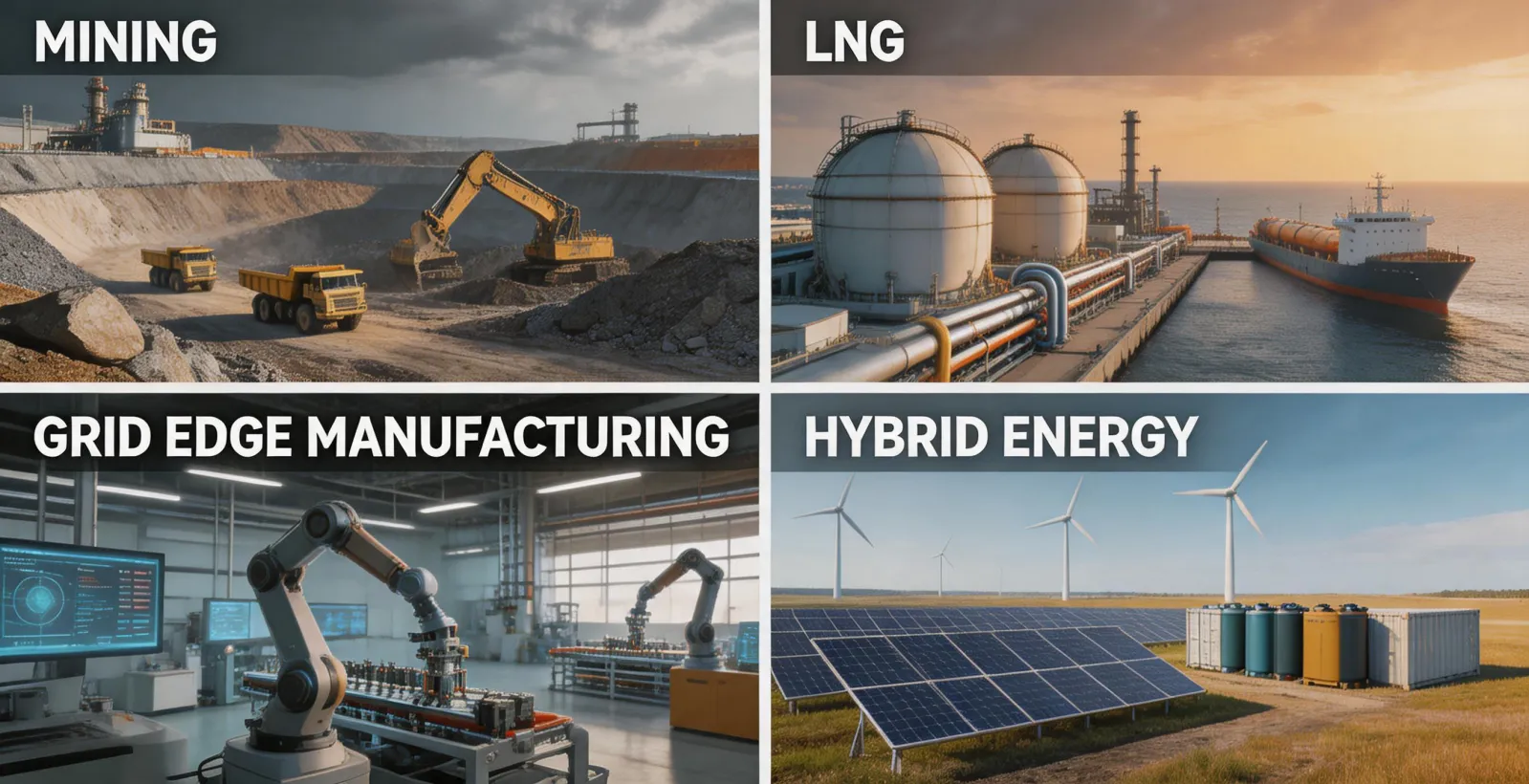
Industrial power decisions are shaped by environmental conditions, response expectations, fuel access, and compliance responsibilities. That is why this page uses horizontally arranged stories instead of a rigid grid. Each industry lens shows a different balance between resilience, efficiency, and transition readiness. Together they illustrate how Air Products treats application context as a design input rather than a sales label, helping clients see where a platform should stay standardized and where it must adapt to the site.
Support for sites where power stability, remote diagnostics, and fast response planning are essential because production loss escalates quickly when systems drift or fail.
Generation and process coordination for facilities where operational continuity and standards discipline must move together under demanding load conditions.
Solutions for clients managing unstable grid quality, growing electrification pressure, and tighter expectations around energy visibility.
System logic for projects blending conventional generation with storage, cleaner fuels, or staged renewable layers while protecting operational confidence.
The case cards below show how Air Products frames industrial modernization differently depending on site maturity and operational risk appetite. In one environment the priority may be resilience under isolated conditions. In another it may be the need to build cleaner energy layers without destabilizing a critical process. By describing transformation this way, we help clients understand that success is less about copying a generic energy trend and more about sequencing changes in a way their teams can sustain.
Remote operations often need fast visibility into load change, strong redundancy logic, and service models that compensate for distance. We structure these programs to protect uptime first and then unlock smarter efficiency gains.
For LNG and gas handling environments, the transition challenge is usually coordination rather than raw equipment capability. Controls, process interfaces, and compliance documentation all need to stay aligned.
Hybrid projects succeed when cleaner technologies are introduced with a dispatch model the site can trust. Our approach focuses on staged integration so innovation strengthens the operating base instead of unsettling it.
Share your industry conditions, power constraints, and transition goals. We will help frame the architecture and service model that best supports your next phase.
Because specification choices rarely sit with a single owner, we document the selection envelope so procurement, operations, and reliability teams can align on duty classification, compliance route, and service strategy before any package is committed.
Electric drive removes underground diesel particulate exposure, reduces ventilation duty by roughly 30–50%, and aligns with 2030 decarbonisation targets adopted by most tier-one operators since 2021. Typical constraints: charging infrastructure capital (USD 2–5 million per shaft), cable-handling discipline, and limited availability at ambient temperatures above 45 °C.
Diesel power remains the proven choice where charging infrastructure is absent or where mine life is under seven years. Tier 4 Final engines in the 250–1,500 kW range keep availability above 90% on most fleets, at the cost of ventilation load, carbon reporting exposure, and a total cost of ownership penalty over a 10-year horizon.
Full autonomy delivers 24/7 duty cycles without fatigue-related derating and produces consistent production records — Rio Tinto's Pilbara iron ore network, commissioned in 2018, is the most frequently cited benchmark. Realistic preconditions: mine plan stability, high-quality survey data, and a 3G/LTE or private 5G coverage layer.
Operator-assisted fleets stay better suited to variable geology, mid-life mines, and jurisdictions where workforce retention is part of the social licence to operate. Teleoperation and assisted-drill retrofits can capture much of the safety uplift without the full autonomy capital profile.
OEM-only keeps warranty coverage and engineered tolerances intact, and is usually the right call for safety-critical interfaces (brake systems, pressure vessels certified to ASME VIII, IECEx-rated enclosures). Qualified aftermarket parts can reclaim 30–60% of spend on wear liners, grinding media, and screen mesh where the metallurgy is independently certified. Our selection rule: OEM for regulated interfaces, aftermarket for wear consumables with documented metallurgy and MSHA/CE acceptance.
Dry processing (HPGR plus air classification or dry magnetic separation) can cut water consumption by more than 90% and eliminate the tailings-dam liability that has driven regulatory tightening since the 2019 Brumadinho failure. Limitations: lower recovery for fine oxide ores (typically 3–8% below wet baseline) and higher dust-management capital. Wet processing remains the default where recovery dominates economics and where flotation chemistry is mature. Hybrid circuits — dry pre-concentration feeding a smaller wet flotation stage — are increasingly used to bridge the trade-off.
| Parameter | Typical operating range | Out-of-envelope condition |
|---|---|---|
| Throughput capacity | 500 – 2,000 t/h (crushing & screening circuits) | Above 2,500 t/h requires staged crushing; below 300 t/h favours modular skids |
| Flow rate (slurry pumps) | 50 – 5,000 m³/h | High-solids duties above 65% by weight require dedicated tailings-grade hydraulics |
| Head pressure | 20 – 200 m (single-stage centrifugal) | Multi-stage or booster train required above 200 m; NPSH-critical below 20 m |
| Engine / prime mover | 250 – 1,500 kW (Tier 4 Final, Stage V) | Not suitable for ambient > 50 °C without derate; electric drive not recommended on mines with fleet life < 5 years |
| Drilling depth | 30 – 500 m | Deep geothermal above 500 m requires high-temperature drill string and specialised mud program |
| Generator output | 500 – 5,000 kVA | Parallel sets above 5,000 kVA demand dedicated switchgear and protection coordination studies |
Values reflect typical mining and energy duty envelopes. Actual package sizing depends on classified-area rating (ATEX, IECEx, MSHA, API Spec Q1), altitude, ambient, and owner-specific compliance routes.